
The die surface temperature monitoring system (DTM) was developed to meet the needs of foundries seeking effective process control for molds’ thermal equilibrium.
The DTM is a robust, durable, and flexible system enabling continous monitoring of the surface temperature of die casting moulds.
The main advantages of the DTM include:
- Extended lifespan of die casting moulds
- Significant enhancement in quality leading to reduced waste
- Optimized lubrication and decreased release agent consumption
- Streamlined lubrication cycle and potential reduction of production cycle time
The sensors
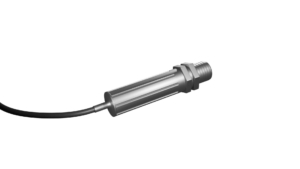
The infrared sensors used in the DTM are equipped with laser pointers that enable precise positioning of measurement points on the surface.
All sensors are fitted with an air connector to ensure consistent sensors cleanliness.
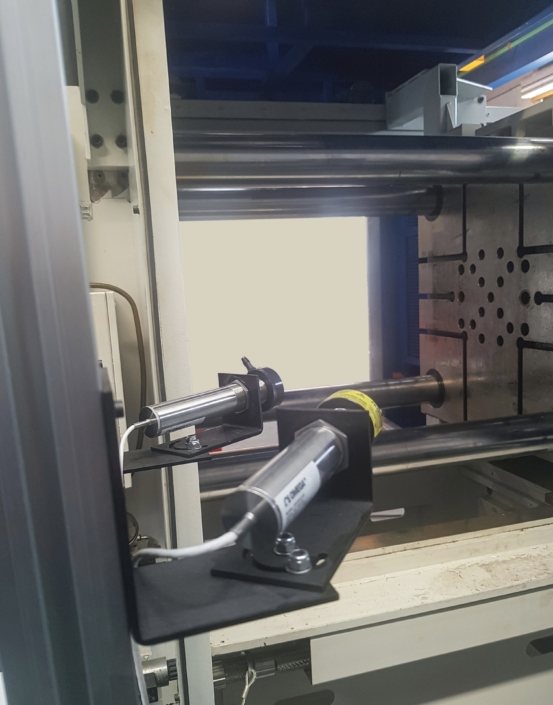
The DTM sensors can be easily configured and oriented to target both fixed and mobile platens. The distance from the machine and the angle of inclination do not affect the quality of measurement.
DTM technology management system
Measurement acquisition software operates on a Windows-based industrial touch PC.
The DTM is equipped with a Siemens PLC, enabling easy interfacing with the press and the workspace via various communication protocols (Ethernet, Profinet, SQL, OPC).
All data can be exported for analysis and post-analysis purposes.
Case studies
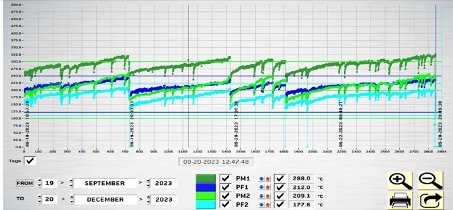
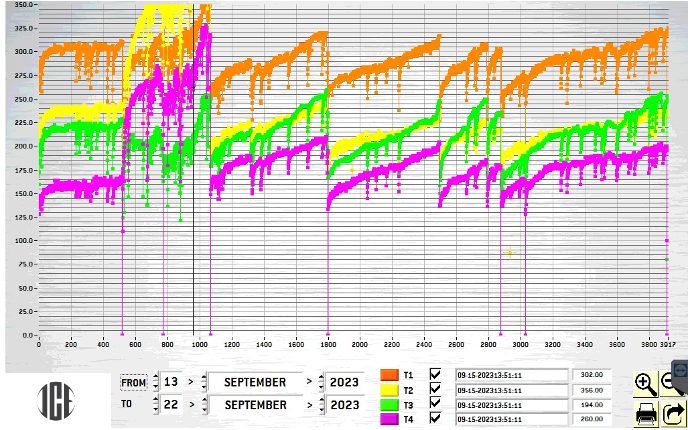
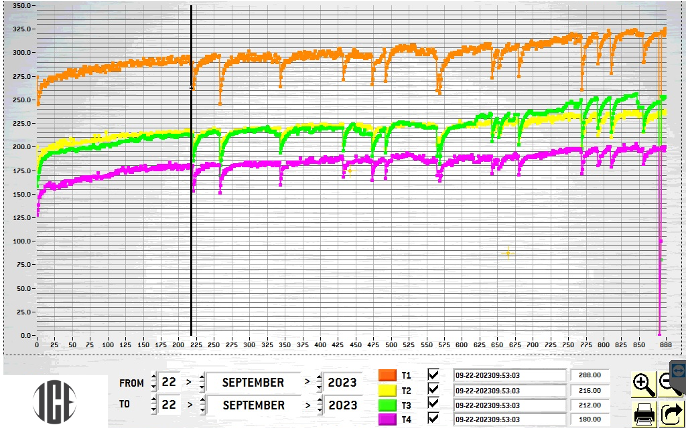
Cases of temperature curve with a 'sawtooth' effect. In these two examples, it's evident how the mould temperature significantly increases from the beginning to the end of the production shift, followed by a decrease at the shift's end.
Monitoring and identifying this behaviour allow interventions to regulate the temperature.
This enables:
- Avoiding excessive use of release agents
- Preventing overstressing the mould with excessively high temperatures and thereby extending its lifespan
- Achieving greater uniformity in the quality of the produced casting
In this case, the temperature tends to rise.
This can result in a variation in the quality of the produced casting as the parameters of the injection process are influenced by the increased surface temperature of the mould.
Moreover, it's highly probable that, to partially counteract this trend, there will be a variation in the lubrication process involving the use of a higher quantity of release agent.
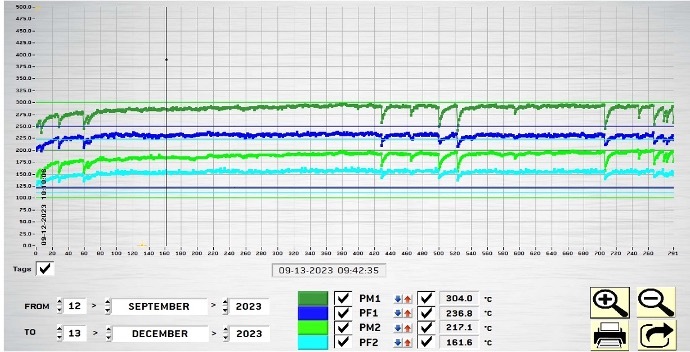
Example of optimal thermal balance: the temperature of all monitored areas remains constant during the production process.
The mould isn’t stressed beyond necessary limits, and the process can be optimized, ensuring greater uniformity in the quality of the die-castings.

 English
  Italiano